Introduction
A trading system that sizes positions from a 90\% prediction interval needs that interval to cover 90\% of outcomes—not on average over a backtest, but tonight, in the volatility regime it is actually in. Conformal prediction [13, 14] is increasingly recommended for this job because it wraps any forecaster in a calibration step with a finite-sample marginal coverage guarantee and no distributional assumptions. The guarantee, however, is proved under exchangeability, and financial returns violate it in every interesting way: volatility clusters, means drift, regimes break. A growing body of practitioner writing asserts that the method transfers anyway.1
Whether it does is an empirical question with a measurable answer, because the failure modes are specific. Exchangeability violations can hurt in three distinct currencies: marginal coverage (the average), conditional coverage (the average within a volatility regime), and transient coverage (the weeks after a structural break). Theory says little about how large each effect is in practice, and published experiments rarely separate them. We separate them by construction: we simulate from four return DGPs whose true conditional quantiles are exactly computable—iid, AR(1) mean, GARCH(1,1), and an abrupt regime break—and run an online protocol (rolling refits, sliding calibration window, one-step-ahead intervals) over 14 methods: split conformal with absolute and volatility-normalized scores, conformalized quantile regression (CQR), Adaptive Conformal Inference (ACI) at four learning rates on both scores, an unconformalized quantile regression, a parametric Gaussian–EWMA interval, and the oracle. Every coverage number below is measured against known truth, and every DGP parameter is sampled from documented ranges and recorded.
Our findings are deliberately split rather than a blanket verdict. Marginal coverage is far more robust to stationary dependence than the exchangeability caveat suggests—and far less robust to breaks. Conditional coverage is the real casualty, and it is repairable at almost no cost. The parametric benchmark every finance reader will ask about is genuinely narrower, but the narrowness is financed by under-coverage.
Contributions.
A reproducible simulation framework of four financial DGPs with exactly computable true conditional intervals, an online evaluation protocol, and a fully sampled-and-recorded design (180 experiments \times 14 methods =2{,}520 method-rows), so marginal, regime-conditional, and post-break coverage are measured against ground truth (Sections 4–5).
A marginal-coverage accounting across dependence types: the exchangeability gap of split conformal is -0.005 [-0.007,-0.003] under GARCH and -0.023 [-0.024,-0.021] under abrupt breaks; ACI holds 0.900 on every DGP, empirically confirming its distribution-free guarantee (Section 6.1).
The headline conditional-coverage accounting on GARCH: the absolute score covers 0.952/0.915/0.820 by true-volatility tercile; an EWMA-normalized score closes the spread from 0.134 to 0.040 (paired +0.094), lifting high-volatility coverage by +0.085; CQR recovers less than half as much (Section 6.2).
An anatomy of the post-break coverage hole and its repairs: depth, duration (\approx the calibration window), the monotone ACI \gamma-vs-width trade-off, and the finding that volatility normalization alone repairs most of the hole for volatility breaks (Section 6.3).
A width-at-matched-coverage comparison against a parametric Gaussian–EWMA baseline, plus a correction to the “Gaussian intervals under-cover fat tails” folklore at central coverage levels (Sections 6.4–6.5).
Related work
Conformal prediction under exchangeability. Conformal prediction originates in the on-line compression framework of [14], whose second edition consolidates two further decades of development [15]. The method wraps any point predictor in a calibration step that converts nonconformity scores into prediction sets with finite-sample marginal coverage, requiring only exchangeability of the data—no model correctness, no distributional assumptions. [13] give the canonical tutorial treatment, and [1] provide a modern introduction oriented toward practitioners. The split (inductive) variant we benchmark was analyzed in depth by [11], who establish distribution-free marginal validity for regression and, crucially for our purposes, also prove that conditional validity is unattainable in finite samples without further assumptions. This marginal-versus-conditional distinction is the fault line our experiments are designed to expose: financial returns are precisely the setting where marginal coverage can be honest on average while being systematically wrong in every volatility regime.
Adaptivity to heteroskedasticity. Within the exchangeable setting, a second line of work makes interval width responsive to the input. [12] conformalize quantile regression (CQR), calibrating intervals built from estimated conditional quantiles and inheriting both the finite-sample guarantee and the local adaptivity of the base learner; locally weighted (normalized) nonconformity scores in [11] pursue the same goal by rescaling residuals with a dispersion estimate—the direct ancestor of the volatility-normalized conformal method we evaluate. [5] push further with distributional conformal prediction, ranking probability-integral-transform values rather than raw residuals; notably, their empirical motivation is a daily stock-return exercise in which the coverage of a mean-residual conformal interval collapses to roughly 50\% in high-volatility periods. That observation is, to our knowledge, the closest published precedent for our regime-stratified accounting, but it appears as a motivating illustration rather than a systematic study.
Conformal prediction beyond exchangeability. Serial dependence breaks exchangeability, and a substantial literature now relaxes it. [4] introduce block-permutation conformal inference and prove approximate validity for strongly mixing time series. [16] propose EnbPI, an ensemble-bootstrap construction with asymptotic marginal coverage under mixing errors and no data splitting. [2] drop exchangeability entirely, deriving a coverage gap bound for weighted conformal prediction governed by the total-variation distance between the test point and the (downweighted) calibration points. In the online setting, [8] introduce Adaptive Conformal Inference (ACI), which tunes the working miscoverage level by online gradient descent and guarantees the correct long-run coverage frequency for arbitrary, even adversarial, distribution shift; [9] strengthen this to coverage guarantees that hold simultaneously over arbitrary subintervals and covariate subsets. [17] analyze ACI’s learning-rate sensitivity on dependent series and propose the expert-aggregation variant AgACI. A common thread deserves emphasis: each relaxation purchases validity in a weaker currency—asymptotic, approximate, long-run-averaged, or TV-bounded—and the papers’ experiments (electricity prices, ozone, synthetic mixing processes) rarely interrogate what those weaker guarantees deliver pathwise, conditionally on a volatility regime, or in the window immediately following a structural break.
Volatility models and interval evaluation in econometrics. Finance has its own mature answer to predictive intervals. The ARCH and GARCH models of [7] and [3] yield conditional-variance forecasts whose implied intervals adapt to volatility clustering by construction—the natural parametric baseline that any conformal method applied to returns must beat or at least match. Equally relevant is the econometric tradition of testing interval forecasts: [10] tests unconditional coverage of VaR exceptions, and [6] adds the conditional-coverage and independence tests that detect exactly the failure mode conformal marginal guarantees permit—correct average coverage with clustered violations. We import the spirit of that toolkit: our regime-stratified and post-break accounting asks Christoffersen’s question—is coverage right conditionally, not just on average?—but answers it against exact ground truth rather than through asymptotic tests on real data.
The gap. The two literatures pass each other by. Conformal-for-time-series theory papers [2, 4, 8, 9, 16, 17] prove validity under specific relaxations of exchangeability and validate on whatever applications are at hand, while a growing body of finance-facing explainer and applied content simply asserts that conformal methods transfer to returns. What is missing is a controlled accounting: simulations from financial DGPs—AR, GARCH, and regime-shift processes—where the true conditional quantiles are known exactly, so that marginal coverage, volatility-regime-conditional coverage, and post-break coverage can each be measured against ground truth rather than proxied. Such a design answers questions the theory leaves open in practice: how badly split conformal under-covers in high-volatility regimes and over-covers in calm ones; how much of that gap volatility normalization and CQR actually recover; how many observations ACI needs to re-cover after a break and at what cost in interval width; and—the question finance practitioners actually face—whether any of this outperforms a plain interval from a fitted volatility model [3], judged by the field’s own coverage criteria [6, 10]. This paper supplies that accounting.
Interval methods
All methods target the central interval at nominal level 1-\alpha with \alpha=0.10. Throughout, \hat\mu(x) is a point forecast and \hat{q}_{\mathrm{lo}}(x),\hat{q}_{\mathrm{hi}}(x) are conditional-quantile forecasts at levels \alpha/2 and 1-\alpha/2, all produced by gradient boosting on causal features of past returns (Section 5).
Split conformal with the finite-sample correction.
Given n calibration scores s_1,\dots,s_n, define the conformal quantile
\begin{equation}
\hat{q}_\alpha \;=\; s_{(\lceil (1-\alpha)(n+1)\rceil)},
\label{eq:cq}
\end{equation} the \lceil
(1-\alpha)(n+1)\rceil-th order statistic, with \hat{q}_\alpha=+\infty when the corrected
rank exceeds n (the honest “infinite
interval” case). With the absolute-residual score s_i=|y_i-\hat\mu(x_i)| the interval is C_t=[\hat\mu(x_t)-\hat{q}_\alpha,\;\hat\mu(x_t)+\hat{q}_\alpha]
(split_abs). If the n+1
scores are exchangeable, 1-\alpha \le
\mathbb{P}(y_{n+1}\in C) \le 1-\alpha + 1/(n+1) [11] (the upper
bound assuming almost-surely distinct scores, which holds for our
continuous scores); with our calibration window n=250 the theoretical coverage is \lceil 0.9\cdot 251\rceil/251 \approx
0.9004.
Volatility-normalized score.
The locally weighted variant [11] divides the residual by a
dispersion estimate: s_i=|y_i-\hat\mu(x_i)|/\hat\sigma_i, giving
C_t=\hat\mu(x_t)\pm
\hat{q}_\alpha\,\hat\sigma_t (split_norm). We use
the practitioner’s cheapest dispersion estimate, a RiskMetrics-style
EWMA \hat\sigma_t^2=\lambda\hat\sigma_{t-1}^2+(1-\lambda)r_{t-1}^2
computed from past returns only.
Conformalized quantile regression.
CQR [12] scores s_i=\max\{\hat{q}_{\mathrm{lo}}(x_i)-y_i,\;y_i-\hat{q}_{\mathrm{hi}}(x_i)\} and reports C_t=[\hat{q}_{\mathrm{lo}}(x_t)-\hat{q}_\alpha,\;\hat{q}_{\mathrm{hi}}(x_t)+\hat{q}_\alpha], inheriting the width adaptivity of the quantile learner.
Adaptive conformal inference.
ACI [8] keeps the conformal machinery but tunes the working level \alpha_t online: \begin{equation} \alpha_{t+1} \;=\; \alpha_t + \gamma\,(\alpha - \mathrm{err}_t), \qquad \mathrm{err}_t = \mathbf{1}\{y_t \notin C_t\}, \label{eq:aci} \end{equation} so a miss (\mathrm{err}_t=1) lowers \alpha_t and widens the next interval, and a hit tightens it.2 For any data sequence, |\frac{1}{T}\sum_{t\le T}\mathrm{err}_t-\alpha|\le (\max(\alpha_1,1-\alpha_1)+\gamma)/(\gamma T); at our test length T=1500 the bound is 0.121/0.061/0.031/0.013 for \gamma=0.005/0.01/0.02/0.05. We run ACI on top of both the absolute and the normalized score at all four \gamma values.
Baselines and oracle.
raw_qr reports the unconformalized quantile-regression
band [\hat{q}_{\mathrm{lo}},\hat{q}_{\mathrm{hi}}]—what
a practitioner gets by skipping calibration. param_gauss is
the parametric benchmark: a Gaussian interval \hat\mu(x_t)\pm
z_{1-\alpha/2}\,\hat\sigma_t^{\mathrm{QML}} whose EWMA decay is
refit on each training window by Gaussian quasi-maximum-likelihood over
the grid \lambda\in\{0.80,0.81,\dots,0.99\} —an
IGARCH/RiskMetrics-style stand-in for the GARCH tradition [3,
7]. oracle is the DGP’s true conditional interval,
the efficiency yardstick: all widths below are reported as ratios to
it.
Simulation framework
Every DGP emits returns of the form \begin{equation} r_t \;=\; \mu_t + \sigma_t\, z_t, \label{eq:dgp} \end{equation} where z_t are i.i.d. standardized (zero-mean, unit-variance) innovations—Gaussian, or Student-t with \nu\in\{4,6,10\} scaled by \sqrt{(\nu-2)/\nu}—and (\mu_t,\sigma_t) are the true conditional mean and standard deviation given the past. The true conditional interval at level 1-\alpha is therefore exactly [\mu_t+\sigma_t F_z^{-1}(\alpha/2),\;\mu_t+\sigma_t F_z^{-1}(1-\alpha/2)] at every step, which is what makes coverage exactly measurable. Four processes span the failure modes (Figure 1):
iid: constant (\mu,\sigma)—the exchangeable base case where the split-conformal theorem applies verbatim.
AR(1): predictable mean \mu_t=\mu+\phi\,(r_{t-1}-\mu), constant \sigma (dependence without heteroskedasticity).
GARCH(1,1): \sigma_t^2=\omega+a\,(r_{t-1}-\mu)^2+b\,\sigma_{t-1}^2 with \omega=\sigma^2(1-a-b) [3]—volatility clustering; stationary but not exchangeable. The true \sigma_t comes from the recursion itself.
break: iid base with an abrupt shift at step t^\ast: \sigma\to\kappa\sigma and/or \mu\to\mu+\delta.
Sampled design (nothing hidden).
Each experiment draws its DGP from documented ranges, all recorded in the released per-experiment records: base volatility \sigma\sim\mathrm{LogUniform}[0.005,0.02] per step; drift \mu\sim\mathrm{Uniform}[-0.1\sigma,0.1\sigma]; Student-t innovations with probability 0.5 (\nu uniform on \{4,6,10\}); \phi\sim\mathrm{Uniform}[0.1,0.5]; a\sim\mathrm{Uniform}[0.05,0.20] and b\sim\mathrm{Uniform}[0.70,0.92] with a+b capped at 0.97; break type volatility/mean/both with probabilities 0.4/0.2/0.4, volatility multiplier \kappa\in\{2,4\}, mean shift \delta=\pm\mathrm{Uniform}[1,2]\cdot\sigma, and break time uniform over the [30\%,60\%] stretch of the test segment so post-break behavior is always observable. The full batch runs 36/36/48/60 experiments on iid/AR(1)/GARCH/break (more where the questions live), i.e. 180 experiments; realized innovation splits are 20/16, 13/23, 31/17, and 32/28 Gaussian/Student-t respectively. With 14 method-rows per experiment the result set has 2{,}520 rows. Everything is deterministic given the released seed (20260610); the full batch takes about six minutes on one core.
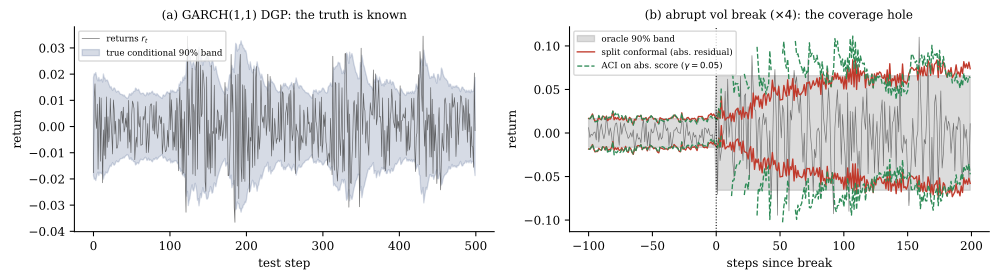
Experimental setup
Online protocol.
Each experiment walks forward through 1{,}500 test steps producing a one-step-ahead interval from every method at every step. The learners are refit every 250 steps on the 600 observations immediately preceding the calibration window (so a model can be up to {\sim}500 steps stale at the end of a refit block); the calibration set is the most recent 250 nonconformity scores, re-scored under the model currently in force and slid forward every step (newly observed outcomes enter immediately). ACI states update every step from the realized cover/miss of their own interval, as in [8]. The point and quantile learners are gradient boosting machines (100 trees, depth 2, learning rate 0.08; quantile loss for \hat{q}_{\mathrm{lo}},\hat{q}_{\mathrm{hi}}) over strictly causal features: five lagged returns, |r_{t-1}|, a rolling mean, rolling standard deviations over windows 5 and 20, and an EWMA volatility. The EWMA decay used by the normalized score is itself sampled per experiment, \lambda\sim\mathrm{Uniform}[0.90,0.97], so results do not hinge on a tuned constant. The true (\mu_t,\sigma_t) are used only for scoring and the oracle; no learner ever sees them.
Metrics.
For each experiment and method we record marginal coverage; mean width as a per-step ratio to the oracle width; coverage and width stratified by true-volatility tercile (terciles of \sigma_t within the test path—defined whenever \sigma_t varies); the tercile coverage spread (max minus min); for break experiments, coverage in the event-time windows 0–60, 60–150, 150–300, 300–600 after the break, the hole depth (minimum of the rolling-60-step coverage after the break), and the recovery time (first step at which rolling-60 coverage returns above 1-\alpha-0.03=0.87); and the fraction of unbounded (infinite) intervals, which only ACI can produce. Aggregates are means over experiments with normal-approximation 95\% confidence intervals; paired method comparisons difference the per-experiment values. We never report an aggregate whose stratified breakdown reverses it.
Results
Marginal coverage survives stationary dependence almost exactly
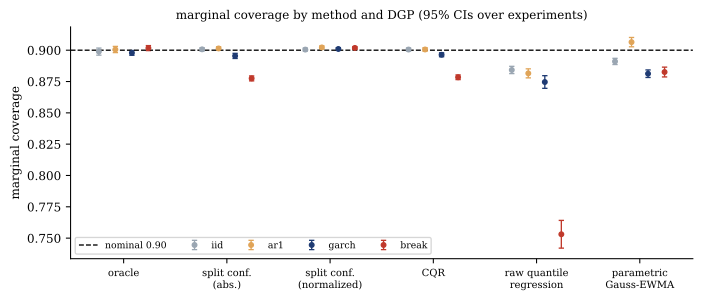
Table 1 and Figure 2 give the marginal accounting. On iid data split conformal delivers its theorem: coverage 0.901 against the theoretical 0.9004. The interesting cells are the non-exchangeable ones. Under AR(1) dependence the gap is statistically invisible (+0.001, with a CI of [-0.000,+0.003] that includes zero). Under GARCH—where consecutive scores are strongly dependent through the volatility state—the gap is real but tiny: coverage 0.895, a gap of -0.005 [-0.007,-0.003]. For marginal coverage under stationary dependence, the exchangeability caveat is, at this sample size, a rounding error.
Breaks are different in kind: split-absolute drops to 0.877 (gap -0.023 [-0.024,-0.021])—modest on average only because the test window is long; Section 6.3 shows the damage is concentrated. Three further observations. First, ACI is the marginal-coverage instrument its theorem promises: across every DGP, score, and \gamma, its coverage lies in [0.900,0.901]—deviations from nominal at least an order of magnitude inside the worst-case bounds of Section 3. Second, the normalized split conformal is marginally clean everywhere including breaks (0.902): the EWMA proxy in the score tracks the volatility jump within steps, so the calibration distribution barely moves. Third, conformalization is doing real work: the raw quantile-regression band under-covers everywhere (0.884/0.882/0.875 on iid/AR(1)/GARCH) and collapses to 0.753 on breaks, and the parametric Gaussian–EWMA baseline under-covers on three of four DGPs (0.891/0.881/0.883 on iid/GARCH/break).
| Method | iid | AR(1) | GARCH | break |
|---|---|---|---|---|
| Oracle (true quantiles) | 0.899 | 0.901 | 0.898 | 0.902 |
| Split conformal (absolute) | 0.901 | 0.901 | 0.895 | 0.877 |
| Split conformal (normalized) | 0.900 | 0.902 | 0.901 | 0.902 |
| CQR | 0.901 | 0.901 | 0.896 | 0.878 |
| ACI, abs. score (\gamma{=}0.01) | 0.900 | 0.900 | 0.901 | 0.900 |
| ACI, norm. score (\gamma{=}0.01) | 0.900 | 0.900 | 0.900 | 0.900 |
| Raw quantile regression | 0.884 | 0.882 | 0.875 | 0.753 |
| Parametric Gauss–EWMA | 0.891 | 0.906 | 0.881 | 0.883 |
Conditional coverage is where it breaks—and normalization is the cheap fix
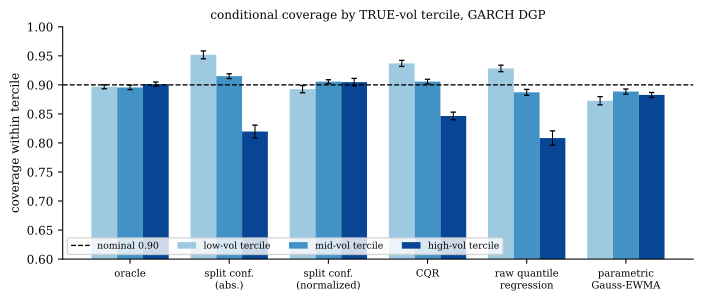
Marginal honesty can hide conditional dishonesty [6, 11]. Stratifying GARCH coverage by the true-volatility tercile of each step (Table 2, Figure 3) exposes the headline failure: split conformal with the absolute score covers 0.952/0.915/0.820 across low/mid/high-volatility terciles—a spread of 0.134. The mechanism is structural, not statistical: the absolute score produces an (essentially) constant-width interval, which is 1.39\times the oracle width in the calm tercile and 0.89\times in the volatile one. The interval is too wide exactly when wide intervals are cheap and too narrow exactly when a position sizer needs the stated guarantee—under-covering by 8 points at nominal 90\%.
Normalizing the score by the EWMA volatility closes most of the gap: 0.893/0.905/0.905, spread 0.040. The paired per-experiment spread reduction is +0.094 [+0.076,+0.112], and the paired high-volatility coverage gain is +0.085 [+0.077,+0.093]. CQR, often recommended as the heteroskedasticity fix, is only a partial one here: 0.937/0.906/0.846, spread 0.093, a paired spread reduction of +0.041 [+0.034,+0.049] and a high-volatility gain of +0.027 [+0.021,+0.033]—its gradient-boosted quantile learners react to the volatility features too sluggishly, leaving high-volatility intervals at 0.90\times the oracle width. Two honest footnotes to the headline. The oracle itself shows a measured spread of 0.022—the sampling floor of the metric, against which the normalized score’s 0.040 should be read. And ACI with an aggressive learning rate (\gamma=0.05, absolute score) also flattens the terciles (0.896/0.899/0.907, spread 0.028) by construction—it chases its own misses—but does so at the price of 3.2\% unbounded intervals on GARCH and a width that swings with the regime rather than tracking it.
| Coverage by tercile | Width / oracle | |||||
| Method | low | mid | high | spread | low | high |
| Oracle | 0.897 | 0.896 | 0.901 | 0.022 | 1.00 | 1.00 |
| Split conformal (absolute) | 0.952 | 0.915 | 0.820 | 0.134 | 1.39 | 0.89 |
| Split conformal (normalized) | 0.893 | 0.905 | 0.905 | 0.040 | 1.06 | 1.10 |
| CQR | 0.937 | 0.906 | 0.846 | 0.093 | 1.24 | 0.90 |
| ACI, abs. score (\gamma{=}0.05) | 0.896 | 0.899 | 0.907 | 0.028 | 1.08 | 1.11 |
| Raw quantile regression | 0.928 | 0.887 | 0.808 | 0.120 | 1.17 | 0.81 |
| Parametric Gauss–EWMA | 0.873 | 0.889 | 0.883 | 0.036 | 0.99 | 1.01 |
Breaks: the coverage hole, and what ACI buys
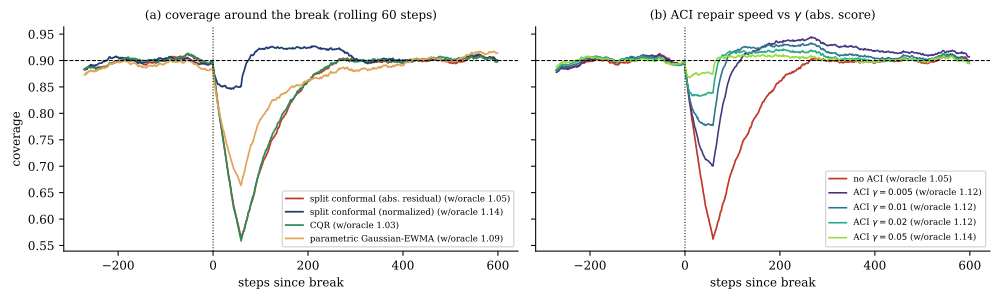
Table 3 and Figure 4 dissect the break DGP in event time. Split conformal with the absolute score covers only 0.562 over the first 60 post-break steps; its average hole depth (minimum rolling-60 coverage) is 0.543 [0.516,0.571]. The hole is transient by mechanism: the calibration window (250 steps) gradually fills with post-break scores, and the rolling coverage is back above 0.87 after a median of 191 steps and fully at nominal by steps 300–600 (0.901). CQR behaves identically (0.559 first-60): conformalizing a quantile learner does not help when the calibration distribution itself is stale. For calibration, note the oracle’s own hole depth is 0.801 and its recovery time is 60 (the metric’s floor): rolling-60 coverage dips that low on 90\%-level Bernoulli noise alone.
The two repairs work, differently. Normalization alone lifts the first-60 coverage to 0.851: 50 of our 60 realized breaks move volatility, the EWMA proxy reacts within steps, and the normalized calibration scores stay nearly exchangeable across the break. ACI repairs by feedback, and its learning rate buys speed monotonically: first-60 coverage 0.700/0.777/0.839/0.875 for \gamma=0.005/0.01/0.02/0.05 on the absolute score, with recovery medians shrinking 93.5/77/66/61 steps. The price is width (1.12–1.14\times oracle on the break DGP, versus 1.05\times for plain split-absolute), occasional unbounded intervals (3.0\% of steps at \gamma=0.05), and post-hole over-coverage while the loop pays back its debt (up to 0.935 at steps 150–300 for \gamma=0.005)—the long-run average is protected by oscillation, not by clairvoyance [8, 17]. Stacking the fixes is best: ACI on the normalized score at \gamma=0.01 reaches 0.875 in the first 60 steps and 0.924 at 60–150; at \gamma=0.05 it shows essentially no hole at all (0.900 first-60; hole depth 0.847, shallower than the oracle’s own 0.801 noise floor) for 1.19\times oracle width and 0.7\% unbounded steps. The unconformalized quantile regression, for contrast, never really recovers: 0.459 in the first 60 steps, still 0.671 at 300–600, and only 86.7\% of its paths ever regain the 0.87 threshold.
| Coverage in window | ||||||
| Method | 0–60 | 60–150 | 300–600 | hole | recovery | width |
| Oracle | 0.896 | 0.910 | 0.896 | 0.801 | 60 | 1.00 |
| Split conformal (absolute) | 0.562 | 0.764 | 0.901 | 0.543 | 191 | 1.05 |
| Split conformal (normalized) | 0.851 | 0.922 | 0.903 | 0.816 | 64.5 | 1.14 |
| CQR | 0.559 | 0.771 | 0.902 | 0.540 | 190.5 | 1.03 |
| ACI abs., \gamma{=}0.005 | 0.700 | 0.909 | 0.916 | 0.694 | 93.5 | 1.12 |
| ACI abs., \gamma{=}0.01 | 0.777 | 0.923 | 0.906 | 0.771 | 77 | 1.12 |
| ACI abs., \gamma{=}0.02 | 0.839 | 0.914 | 0.902 | 0.819 | 66 | 1.12 |
| ACI abs., \gamma{=}0.05 | 0.875 | 0.907 | 0.901 | 0.843 | 61 | 1.14 |
| ACI norm., \gamma{=}0.01 | 0.875 | 0.924 | 0.898 | 0.820 | 60 | 1.14 |
| Raw quantile regression | 0.459 | 0.445 | 0.671 | 0.326 | 601.5 | 0.81 |
| Parametric Gauss–EWMA | 0.664 | 0.823 | 0.903 | 0.647 | 149.5 | 1.09 |
Width at matched coverage: what honesty costs, and what narrowness hides
Coverage comparisons are only meaningful at matched coverage, so we compare widths among methods whose marginal coverage falls in the band [0.885,0.915], separately by DGP and innovation family. On GARCH—the economically central case—the conformal premium over the oracle width is: split-absolute 1.15\times (Gaussian innovations) and 1.13\times (Student-t); normalized 1.09\times/1.08\times; CQR 1.08\times/1.06\times. The parametric Gauss–EWMA baseline is the narrowest interval in the comparison, 0.99\times/1.03\times—but its coverage there is 0.878/0.888, below the band’s lower edge in the Gaussian cell and barely inside it under Student-t. Its narrowness is not efficiency; it is under-coverage wearing efficiency’s clothes. The unconformalized quantile regression tells the same story at 0.99\times width and 0.871–0.880 coverage. Across all eight DGP\timesinnovation cells, no method inside the coverage band is narrower than the oracle.
Two practical readings. First, on heteroskedastic data the normalized score is not just the conditional-coverage fix (Section 6.2)—it is also cheaper than the absolute score at matched marginal coverage (1.08–1.09\times vs 1.13–1.15\times), because matching the oracle’s shape lets it match the oracle’s average width more closely. There is no width-vs-honesty trade-off in choosing it. Second, the honest premium for distribution-free finite-sample coverage on GARCH is roughly 6–9\% of interval width (normalized or CQR) over an oracle no real forecaster possesses—a modest insurance premium against the parametric alternative’s silent 1–2-point coverage shortfall.
Fat tails are not why the Gaussian baseline fails at 90%
A folklore argument says Gaussian intervals under-cover financial returns because returns are fat-tailed. At the 90\% level this is backwards. The central 90\% interval is set by the 0.95 quantile, and for standardized (unit-variance) Student-t innovations that quantile is smaller than the Gaussian 1.645: 1.507/1.587/1.621 for \nu=4/6/10. Fat tails move mass from the shoulders to both the tails and the center; at central coverage levels the center wins, and a correctly-scaled Gaussian interval over-covers. The ordering only flips deep in the tails (at the 0.995 quantile: 3.256 vs. 2.576 for \nu=4), which is where the folklore belongs—VaR at 99\%+, not 90\% intervals.
Our measurements bear this out: the parametric baseline covers slightly more under Student-t innovations than under Gaussian ones (0.894 vs. 0.888 on iid; 0.888 vs. 0.878 on GARCH), the opposite of the folklore’s prediction. Its under-coverage is instead driven by volatility dynamics—estimation noise in the EWMA filter on iid data, filter lag under GARCH, and stale variance after breaks (0.664 in the first 60 post-break steps)—failure modes that conformal calibration absorbs and a plug-in z-score does not. Practitioners patching a Gaussian interval for “fat tails” at the 90\% level are treating the wrong disease.
Discussion
A practical recipe.
The results compose into a simple default for return intervals at central coverage levels. (1) Always conformalize: the raw quantile-regression band gives up 1.6–2.5 coverage points on stationary DGPs and 15 points after breaks, while calibration costs one data split. (2) Normalize the score by a volatility proxy—even a fixed-decay EWMA. It closes the conditional-coverage spread from 0.134 to 0.040, repairs most of the volatility-break hole (0.851 vs. 0.562 first-60 coverage), keeps marginal coverage at nominal on every DGP we tested, and is narrower than the absolute score at matched coverage on heteroskedastic data. It is the rare free lunch in this menu. (3) If regime breaks are a first-order concern, add ACI on top of the normalized score, choosing \gamma by the hole-vs-oscillation trade-off of Table 3; \gamma\approx0.01 already cuts the hole substantially at negligible marginal-width cost, and \gamma=0.05 eliminates it at {\sim}1.19\times oracle width with a small fraction of unbounded steps that a deployment must handle (cap the width or abstain). CQR is a reasonable method, but on these DGPs it neither matches the normalized score conditionally nor survives breaks better than the absolute score, so it is not the first tool we would reach for.
What conformal buys against a parametric volatility model.
The Gauss–EWMA baseline embodies the econometric default: model the variance, plug in a quantile. When its assumptions are close to true it is the narrowest interval on offer—and it still under-covered in six of our eight DGP\timesinnovation cells, because estimation noise, filter lag, and breaks all push the same direction and nothing in the plug-in construction pushes back. Conformal calibration is exactly that counter-pressure: it converts whatever interval shape one believes in (including the parametric one) into a coverage-honest version of itself for a 6–9\% width premium. The right mental model is not “conformal vs. GARCH” but “calibrated vs. uncalibrated”: normalize by the best volatility estimate available, then let the calibration set vote on the quantile. When the volatility model is good, the premium is small; when it is wrong, the calibration step is what keeps the stated 90\% meaning 90\%—marginally always, conditionally if the normalizer tracks the regime, and after breaks if ACI is listening.
Limitations
Everything here is simulation, by design: exact conditional truth is the point of the paper and is unobtainable on market data. The cost is a list of simplifications, all visible in the released code. The DGP menu—iid, AR(1) mean, GARCH(1,1), single abrupt break, with Gaussian or standardized Student-t innovations—omits leverage effects, jumps, skewed innovations, long memory, and recurring or gradual regime shifts. We study one asset and one horizon (one-step-ahead); cross-sectional and multi-horizon questions are out of scope. The learners are gradient-boosting machines with fixed, untuned hyperparameters (100 trees, depth 2, learning rate 0.08); a stronger or better-tuned quantile learner would likely improve CQR specifically, and our ranking of CQR versus the normalized score should be read with that asymmetry in mind. The online protocol fixes one cadence (refit every 250 steps, train 600, calibrate 250); the post-break recovery time scales with the calibration window by mechanism, so these constants shape the transient results. The parametric baseline is a QML-fitted EWMA filter, not a full GARCH(1,1) maximum-likelihood fit; on the GARCH DGP a correctly-specified MLE baseline would be stronger, though it would not change the structural point that plug-in intervals lack a calibration feedback. The nominal level is 0.90 throughout; at deeper tail levels (e.g. 99\%+) the fat-tail ordering of Section 6.5 reverses and several conclusions about the Gaussian baseline would quantitatively change. Finally, confidence intervals are normal approximations over independent experiments, appropriate for the 36–60 replications per DGP but not a substitute for exact inference.
Conclusion
We measured what conformal prediction actually delivers on financial-return DGPs where the truth is known. Marginal coverage survives stationary dependence almost exactly—the exchangeability gap is -0.005 under GARCH and invisible under AR(1)—so the common warning that serial dependence voids conformal guarantees is, marginally and at this scale, overstated. What breaks is everything a risk manager actually cares about beyond the average: the absolute-score interval under-covers high-volatility regimes by 8 points while over-covering calm ones by 5, and abrupt breaks open a coverage hole that reaches 0.562 over the first 60 steps and heals only as fast as the calibration window. Both failures have cheap, composable fixes: an EWMA-normalized score (spread 0.134\to0.040; hole 0.562\to0.851; marginal coverage intact everywhere; narrower at matched coverage), and ACI for the residual break risk (hole repair monotone in \gamma at a 1.12–1.14\times width cost, long-run coverage 0.900 by theorem and by measurement). The parametric Gaussian–EWMA alternative is narrower than every honest method—because it under-covers; its narrowness is bought with coverage, and its failures at the 90\% level stem from volatility dynamics, not the fat tails folklore blames. Conformal prediction for returns is neither a guarantee that transfers unscathed nor a method broken by dependence: it is a calibration layer whose marginal promise is cheap to keep, whose conditional promise must be earned with a volatility-aware score, and whose post-break promise needs a feedback loop. Used that way, it turns a 6–9\% width premium into intervals whose stated level survives the regimes where parametric confidence quietly fails.
Reproducibility.
All experiments are deterministic given the released seed (20260610). The script
scripts/run_all.py regenerates every record, summary, and
number in this paper (results/results.json,
records.csv; about six minutes on one core),
python -m conformal_experiments.figures regenerates all
four figures, scripts/check_paper_numbers.py asserts that
every number quoted in this paper matches the generated results, and a
17-test suite checks the DGP ground
truths and the conformal theorems (including the ACI update direction).
The DGPs, methods, protocol, and analysis are released as an open-source
package at the repository above.
References
The specific practitioner advice under test here—including the claim that split conformal transfers to returns essentially unchanged, the EWMA-normalized score, and an ACI variant for regime shifts—originates in the author’s own earlier practitioner draft (a market-making blog post on conformal prediction for position sizing). This paper is therefore a controlled self-audit of advice the author has himself circulated, not an attack on a third party. The audit caught a concrete bug: the draft’s ACI pseudocode updates the conformal quantile with a sign such that a missed interval narrows the next one—the opposite of the Gibbs–Candès recursion. The corrected update (Eq. (aci)) is pinned by a unit test in the released code.↩︎
Note the direction; the practitioner draft audited here got it backwards (see the footnote in the Introduction). When \alpha_t wanders to \le 0 the corrected rank in Eq. (cq) exceeds n and the interval is all of \mathbb{R} (always covers); when \alpha_t\ge 1 it is empty. Both conventions are required by the ACI guarantee; in our released runs only the always-cover case ever occurs (the empty-interval case never triggers), and the fraction of unbounded steps is reported wherever it is non-negligible.↩︎